

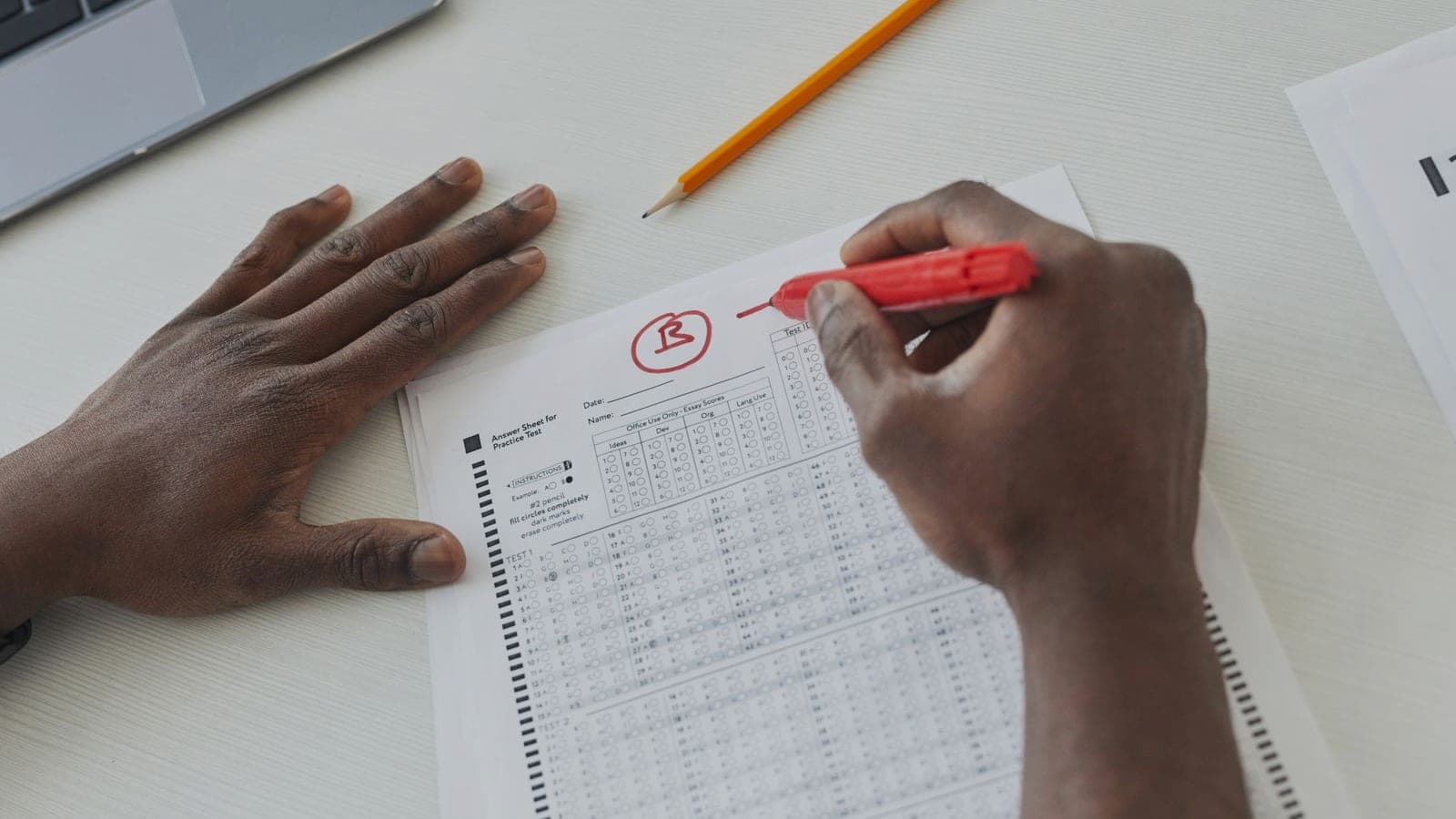
How to Check Your Own Answers to Practice Questions
Published October 27, 2026
To check your own answers to practice questions, write the answer first, compare it with a mark scheme or a reliable solution line by line, give yourself points only for what you actually wrote, and then work out why each lost point was lost. The last part is the one most students skip, and it is where the learning is.
Doing a pile of practice questions and glancing at the answers feels like revision. It is not much more than that, because the value of a practice question comes from the feedback you take from it. A wrong answer you understand is worth more than a right answer you guessed.
Why checking matters more than doing
Answering a practice question is a test of your memory. Checking it is what turns the test into learning. If you never find out what you got wrong, and why, the next time the same idea appears you will make the same mistake with the same confidence.
Research on testing supports this. Butler and Roediger (2008), in a study you can read at Memory and Cognition, found that when students got feedback after a multiple-choice test, they remembered the right answers much better on a later test than students who got none, and the feedback reduced the damage from wrong answers they had chosen. Testing helps, but testing plus feedback helps more.
There is another reason. People are poor judges of how well they know something. Material that feels familiar after rereading often cannot be produced in an exam. Marking your own practice answers honestly is one of the cheapest ways to find out what you really know. If you want the wider picture of testing yourself, see active recall.
Before you check: do the question properly
Self-marking only works if the answer was a real attempt. A few habits make the difference.
- Answer from memory, with your notes closed, in the same way you will in the exam.
- Write the full answer, not a plan in your head. Thinking "I know how to do that" is not the same as doing it.
- For time-limited exams, set a timer, so you also learn how much you can do in the time.
- If you are not sure about a point, mark it with a small question mark. You will check those first.
If you cheat at this stage by looking things up, the marking afterwards tells you nothing. Keep the two steps apart: first you answer, then you check.
Step 1: Get a good answer to check against
You need a reliable reference. In order of preference:
- An official mark scheme. Exam boards publish them for past papers. They show not only the final answer but also how points are given, which is exactly what you need.
- A worked solution from your teacher or textbook. Good for maths and sciences, as long as it shows the steps.
- A model answer you build yourself. If nothing exists, write a short list of what a full answer must contain, using your textbook and lecture notes, before you look at your own work. Doing it first stops you from adapting the list to fit what you wrote.
- A classmate or teacher. For essays and open questions, another person is the best checker. Even checking one or two answers a week helps.
Be careful with answer keys found online. Some are wrong, and some give the final number with no working. If your answer and the key disagree, do not assume either is correct until you have worked out why.
Step 2: Mark line by line, not by feel
The most common error in self-marking is judging the whole answer by how it feels. "That was about right" is a trap. Instead, mark the way an examiner does.
- Take the mark scheme and go through it one point at a time.
- For each point, find the exact words or steps in your answer that earn it, and underline them.
- If you cannot find them, the point is lost, even if you "meant" it.
- Write the score for each part in the margin, then add them up.
A good test is to imagine a stranger reading only what is on the page. Would they give you the point? If it needs your explanation, it does not count.
For maths and science, check both the method and the result. If your final number matches but your steps are different, compare them with the solution. A right answer reached through two mistakes that cancel each other is a trap that costs marks later.
For essays and long answers, check against a list: Did I answer the question that was asked? Did I make each point and back it with evidence? Did I use the key terms correctly? Is the conclusion linked to the question? That is more reliable than a general feeling of "good" or "weak".
Step 3: Find the reason behind every lost point
This is the step that changes your next result. For every point you lost, name the cause. Most lost points fall into a small number of categories.
- Knowledge gap. You did not know the fact, definition or method. The fix is to learn it and then test it again.
- Misunderstanding. You thought you knew it, but your idea was wrong. This one is the most important to catch, because it feels like knowledge. The fix is to understand the idea properly, not just memorise the right answer.
- Careless error. You knew it but made a slip: a sign, a unit, a misread question. The fix is a checking habit, not more content.
- Did not answer the question. You wrote something true but not what was asked. The fix is to underline the command word (explain, compare, evaluate) before you write.
- Ran out of time. You knew it but could not finish. The fix is timed practice and deciding what to do first.
- Weak writing. The idea was there but unclear or missing a step. The fix is to practise writing full answers and compare with the model.
Write the category next to each lost point. After ten questions you will see a pattern. Maybe half of your losses are careless errors, and the answer is not "study more", but "slow down and check units". Maybe most come from one topic. Now you know what to study next.
Step 4: Keep a mistake log
A mistake log is a notebook, a page or a note on your phone where you record each lost point once. Keep it short. For each one, write:
- The question or topic in a few words
- What you wrote or did
- What the correct answer or step is
- The category of the mistake
Then use it. Before your next practice session, read the last few entries. Before the exam, go through the whole log. It is a list of the points most likely to cost you marks, written by you, based on your real errors.
You can also turn entries into practice. For a knowledge gap, make a flashcard. For a method error, redo a similar question from scratch a few days later without looking at the solution. Retrying later is what shows the fix has stuck, and spacing your attempts, as we explain in spaced repetition and the forgetting curve, makes the learning last longer.
Step 5: Redo what you got wrong
Reading the correct solution and thinking "I see" is another trap. Understanding a solution someone else wrote is much easier than producing one yourself. The test of whether you learned from a mistake is whether you can now do it.
So after marking, close the solution and redo the question, or a very similar one. If you can do it from a blank page, the mistake is fixed. If you cannot, the gap is bigger than it looked, and you have just found that out in practice instead of in the exam.
This is also why you should not spend your whole session on new questions. A balance of about half new questions and half redoing earlier mistakes is a reasonable rule, since the mistakes are where the largest gains are.
When there is no answer key
Sometimes you have a question and nobody to tell you if you are right. These approaches help.
- Check the reasoning, not just the answer. Re-solve the problem in a different way if you can, or substitute your answer back into the question to see if it works.
- Use the textbook as your reference. For explain-type questions, find the relevant section and list the key points in it, then compare.
- Ask a friend to tell you only how many points you lost, not where. Then try to find them yourself. It shows whether your confidence matches your performance.
- Do not just re-read your own answer to check it. Your first attempt can make a wrong answer look right on a second read. Re-solve or re-derive it instead.
Doing it with Orbily
Self-marking is hard because you have to judge your own work, and for essays and written answers you do not always have a mark scheme. Orbily's AI Correction can act as a second pair of eyes. Take a photo of your handwritten answer, add the question if you can, and Orbily grades it out of 100, quoting what you actually wrote, with a verdict, strengths, what to rework and detailed corrections. It is a good way to get a first marking when no teacher is available, and you still need to do the real work afterwards: understand each correction, log the mistake and redo the question. You can read more about AI Correction.
Common mistakes when checking your own answers
- Giving yourself the benefit of the doubt. If you have to explain what you meant, the point is not earned.
- Marking only the final answer. Method and reasoning are often worth more than the result.
- Looking at the solution before trying. Once you have seen the answer, you cannot test yourself on that question again.
- Checking only the questions you got wrong. Also check the ones you got right, in case luck or an error that cancelled out gave you the point.
- Moving on without recording the mistake. If it is not written down, you will probably repeat it.
- Never redoing a failed question. Reading a solution is not learning it.
A simple routine for your next session
Here is a routine that fits into an hour.
- Spend 25 minutes answering questions from memory under a timer, with notes closed.
- Spend 15 minutes marking line by line against the mark scheme, and underline where each point is earned.
- Spend 10 minutes writing the cause of each lost point in your mistake log.
- Spend 10 minutes redoing the one or two questions you lost the most points on, with the solution closed.
Repeat this a few times a week and your errors become a short list you can see and fix, instead of a vague worry.
Final thoughts
To check your own answers to practice questions well, answer honestly first, mark line by line against a reliable scheme, name the cause of every lost point, keep a mistake log and redo what you got wrong. The marking is not the end of the session, it is the middle. Next time you do a practice question, give yourself as much time to check it as you spent writing it, and see how quickly the same mistakes stop coming back.
FAQ
For learning, checking soon after is better than waiting days, because feedback is most useful while you still remember your reasoning. For exam practice, finish the whole paper under time first, then mark it. That way you practise both the skill and the pacing.
Use your textbook, your lecture notes or the course syllabus to build a short list of what a full answer must include, before you look at your own work. You can also compare with a classmate's answer, or ask a teacher to check one or two. Marking against a list you wrote beforehand is far fairer than judging by feel.
Not necessarily, but check it. A different method that works is fine. A right answer reached by two errors that cancel out is not, and it will fail you on the next question. Compare your steps with the solution, and if they differ, make sure yours would work on a similar problem too.
Mark against the scheme line by line and give a point only when your answer clearly contains what that line asks for. Write down which words of your answer earn each point. If you have to say 'I meant that', the answer did not say it, so the point is not yours.
Quality matters more than volume. Checking ten questions properly, with a reason for each lost point, teaches you more than skimming through fifty answers. If you are short on time, do fewer questions and spend at least as long on checking as on answering.