

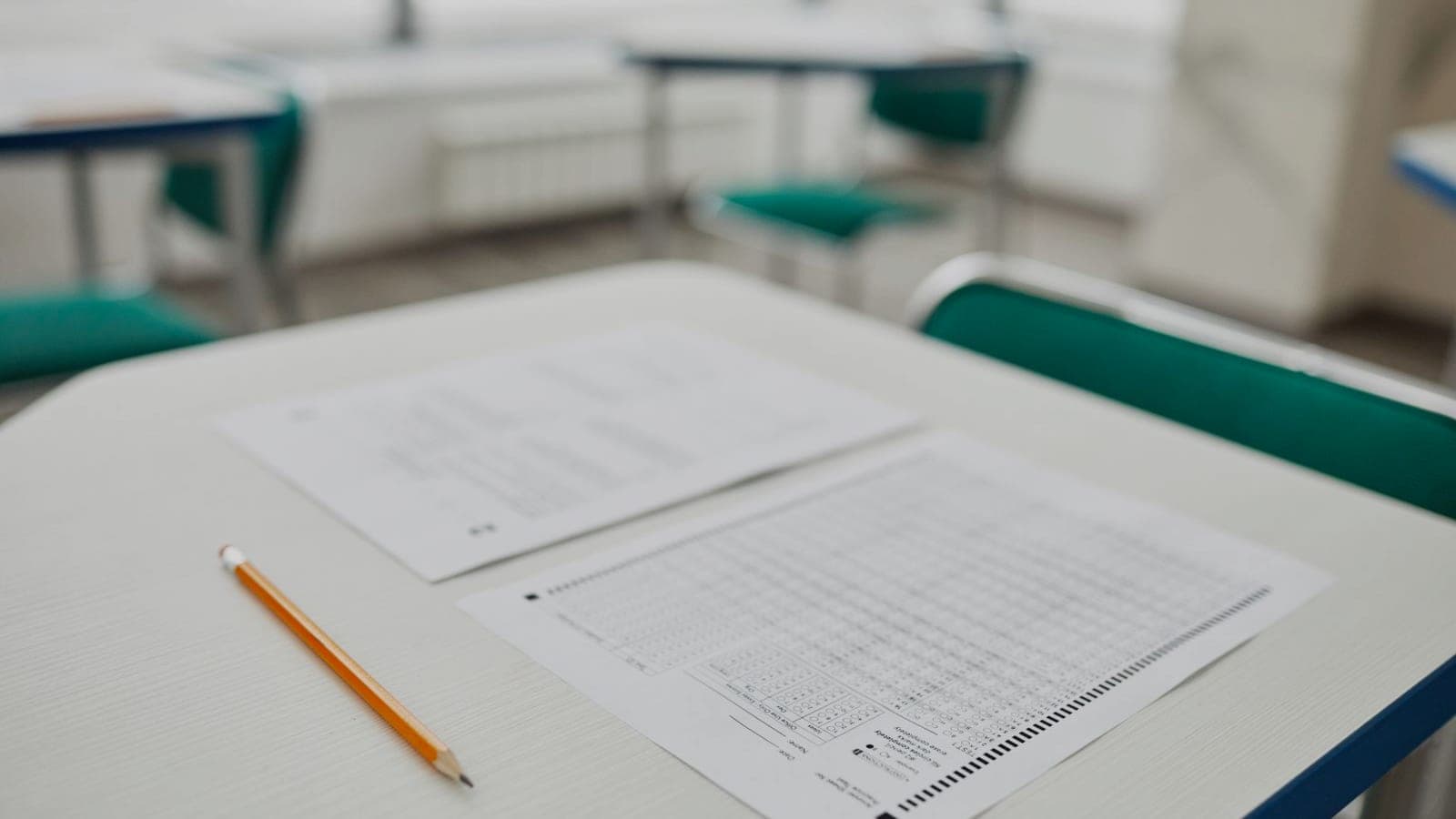
How to Use Past Papers to Revise Properly
Published October 30, 2026
To use past papers well, start with single questions on topics you have studied, move to full timed papers a few weeks before the exam, sit them in real conditions with no notes, mark them against the official mark scheme, and turn every lost mark into a specific fix. The marking and the fixing matter more than the doing. A paper that you complete and never review has taught you very little.
Past papers are the closest thing you can get to the real exam, which is why every teacher recommends them. But many students use them badly. They do a paper with the textbook open, glance at the answers, feel vaguely reassured, and move on to the next one. They have done a lot of papers and learned almost nothing from them.
This guide shows how to get real value from each paper: when to start, how to sit one, how to mark it, and what to do with the result.
Why past papers work
Past papers combine three things that research on learning supports. They make you retrieve information from memory instead of rereading it, which is the idea behind active recall. Roediger and Karpicke (2006) showed that students who tested themselves on a text remembered more a week later than students who studied it again, even though the rereaders felt more confident. You can read the study through Roediger and Karpicke (2006).
They also show you the format. You learn how marks are split, how long questions really take, what the command words mean (describe, explain, evaluate), and which phrases the examiners reward. And they expose your gaps, which is the most useful thing of all: a past paper tells you what you do not know yet, at a moment when you can still fix it.
None of this happens automatically. It happens if you sit the paper properly and review it properly.
When to start
The usual mistake is to save past papers for the last week. By then you can only measure your gaps, not fix them. A better order:
- Early on, use single questions. After you learn a topic, find two or three exam questions on it and answer them. This is practice and feedback in one, and it costs about twenty minutes.
- In the middle, use sections. Do a few questions from different topics together, with a rough time limit.
- Near the end, use full papers. Once you have covered most of the course, sit complete papers in exam conditions. Leave enough time before the exam to act on what you find, ideally a few weeks.
If you are short on time, adapt the plan in how to revise for an exam in a week and place one full paper on day three, so you still have days left to repair the gaps.
How to sit a past paper in real conditions
The aim is to make the paper feel like the exam, so the result tells you something true.
- Get the right paper. Use your exam board's papers for your exact course and level, and check that the syllabus has not changed since the paper was set.
- Set a timer for the real time. Not a generous time, the real one. If you cannot finish, that is useful information about your pace.
- Work somewhere quiet, with only allowed materials. Phone out of the room, notes closed, calculator only if the exam allows it.
- Do it in one sitting. Do not stop to look things up. If you are stuck, make your best attempt and move on, as you would in the exam.
- Mark your doubts as you go. Put a small star next to answers you guessed. Those matter later, because a lucky guess is not knowledge.
- Stop when time is up. Draw a line under where you got to. Then, if you want, keep going in a different colour to see how much more you could do.
If this is your first full paper and you are nervous, it is fine to do the first one untimed to get used to the style. Make the second one timed.
How to mark it honestly
This is where most of the value is, and where most students cut corners. Marking is not checking whether your answer matches. It is finding out exactly why you lost each mark.
- Use the official mark scheme. It shows which points earn marks, which wording is accepted, and how method marks work. Your own idea of a good answer is not the standard.
- Mark in a different colour. This keeps your original attempt visible and stops you from quietly fixing your answers as you mark.
- Be strict. If the scheme asks for a named term and you described it vaguely, you probably do not get the mark. Be your own harshest examiner, because the real one will be.
- Do not give half credit for almost. An answer that is nearly right but missing the key point is where students most often fool themselves.
- Write the reason next to every lost mark. One short phrase is enough.
For writing-heavy answers, the same discipline applies as in checking your own answers to practice questions: compare against a standard, not against your feeling.
Sort every lost mark into a category
The reason you lost a mark decides what you should do about it. Use a small set of categories:
- Did not know it. A gap in knowledge. Fix: go back to the topic, learn it, and make flashcards or questions on it.
- Knew it but could not recall it. Fix: practise retrieval on that point, spaced over days.
- Misread the question. Fix: underline the command word and the number of marks before you start answering.
- Knew the method but made an error. Fix: slow down on that step, check your working, and redo the question.
- Right idea, wrong wording. Fix: study the mark scheme phrasing and learn the exact terms.
- Ran out of time. Fix: practise pacing, and learn to leave a hard question and return to it.
Count how many marks fall into each category. You will often find that one or two categories cause most of the losses, and that is where your effort should go.
Turn the marking into a revision plan
A marked paper with a total at the top is a score. A marked paper with a list of fixes is a plan.
- Write a list of topics you lost marks on. Group the lost marks by topic. Three lost marks on the same topic is a clear signal.
- Order the list by marks lost. Fix the biggest losses first.
- Fix, then retest. For each topic, relearn, then answer a fresh question on it a day or two later without notes. A fix you never test is a hope.
- Keep an error log. One line per mistake: the question, the cause, and the rule you will apply next time. Reread the log before the next paper.
- Redo the same paper later. After a few weeks, sit the questions you missed again. If you can now answer them from memory, the fix worked.
This loop of sit, mark, fix and retest is what separates students who improve across papers from students who plateau.
Make good use of your limited supply of papers
Past papers run out, especially for newer courses. A few ways to stretch them:
- Use single questions across papers. Pull all questions on one topic from several papers and do them together, instead of using up full papers early.
- Mix the questions. Putting questions from different topics in one set is closer to the real exam, and it trains you to recognise the type of question, an idea explained in interleaving study.
- Write your own questions. Turn each heading in your notes into a question, then answer it from memory.
- Use specimen papers and sample materials. Exam boards often publish these when the course changes.
- Check for different styles. If your exam has multiple choice, short answer and essay sections, practise each format.
Mistakes to avoid
- Doing a paper open-book. If you look at notes during the attempt, the score means nothing and you skip the retrieval effort.
- Marking by memory. Without the mark scheme, you will give yourself marks you would not get.
- Collecting papers instead of learning from them. Five unreviewed papers are worse than two reviewed ones.
- Only doing your favourite topics. Papers feel good when you are strong in the topic. Look hardest at the questions you avoid.
- Starting too late. A paper the night before shows you gaps you can no longer close.
- Memorising the answers. If you redo a paper, check understanding by changing a number or the wording, not by recalling last time's answer.
Marking a paper when no mark scheme exists
Sometimes there is no official mark scheme: a teacher's own test, a mock with no solutions, or an essay question. In that case, get as close as you can. Write your own scheme from your notes before you check your answer: list the points a full answer should contain, then compare. Ask a teacher or a classmate to look at the tricky ones.
Orbily's AI Correction can help here, as a first read. You photograph your answer, add the question if you have it, and it grades the work out of 100, quoting what you actually wrote, with a verdict, strengths, what to rework and detailed corrections. It does not replace the official mark scheme when you have one, and it does not do the revision for you: you still need to understand each correction, log the mistake, and redo the question. You can read more about AI Correction.
A simple routine for each paper
To keep it manageable, treat each paper as a four-step job that takes about twice the time of the paper itself.
- Sit it. Real time, real conditions.
- Mark it. Official scheme, strict, in another colour, with a reason for each lost mark.
- Plan it. A short list of topics to fix, ordered by marks lost.
- Retest it. A day or two later, answer new questions on those topics without notes, and update your error log.
If you only have time for two papers, do both properly. Two papers followed by real fixes beat ten papers that were only ticked off.
The short version
Past papers are powerful because they make you retrieve, show you the exam format and reveal your gaps. They only work if you sit them in real conditions, mark them strictly with the official scheme, and turn each lost mark into a fix that you test again. Start with single questions, move to full papers a few weeks before the exam, and measure yourself by what you fix, not by how many you finish.
FAQ
There is no magic number. Many students do a handful of full papers per subject, plus topic questions earlier on. Quality matters more than count: one paper marked carefully and followed by a fix is worth more than three done quickly and never reviewed.
No, not during the attempt. Sit the paper first without help, then mark it. Looking at answers while you work turns a test into reading, and you lose the retrieval effort that makes past papers valuable in the first place.
Reuse them after a gap. Redo old papers a few weeks later and check if you can now answer the questions you missed. You can also write your own questions from your notes, or use questions from textbooks that match your exam style.
Start with your exam board or your school. Most boards publish past papers and mark schemes on their own websites, and teachers often have extra ones. Use the official mark scheme when you mark, because it shows exactly what earns a point.
Start with single questions on each topic soon after you learn it. Move to full timed papers once you have covered most of the course, usually a few weeks before the exam. Doing a full paper too early mostly shows you what you have not learned yet.