

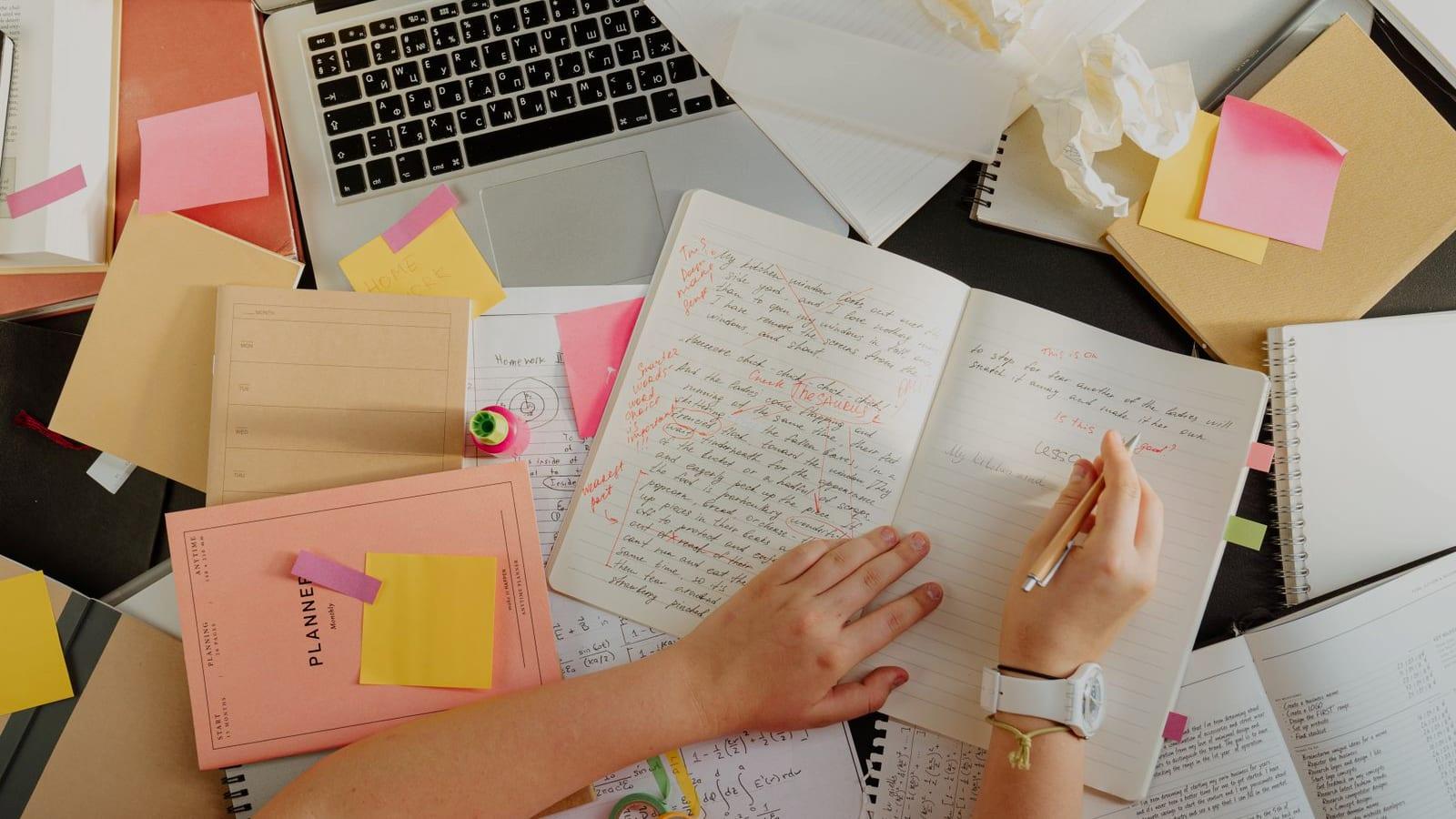
How to Turn Messy Notes Into a Clean Summary
Published November 10, 2026
To turn messy notes into a clean summary, sort them into topics, fill the gaps from your source, cut everything that would not cost you marks, rewrite the rest in your own words on a single page, and then test yourself from that page without looking. The cleaning is not the goal. It is the first round of studying.
Everyone's notes get messy. You write fast to keep up with the lecturer, abbreviate half the words, draw arrows that made sense at the time and squeeze a note into a margin. Two weeks later the page looks like a code you used to know. The temptation is to copy it out neatly. That produces a nicer page and almost no learning.
This guide shows a better way, in five steps, with the reasoning behind each one. It works for handwritten pages, typed notes, photos of a whiteboard, or all three mixed together.
Why neat notes are not the same as a summary
A tidy copy of your notes contains the same things in the same order. It takes time, it feels like work, and your brain can stay in neutral the whole way through. A summary is different, because making one forces you to decide what matters, how ideas connect and how to say them in your own words.
That decision-making is the useful part. Reading and highlighting are among the least effective study techniques in a major review, while practising retrieval and spacing your study come out much better (Dunlosky and colleagues, 2013, in Psychological Science in the Public Interest). A clean summary does not replace those. It gives you something compact to practise from.
So think of it as two jobs. First, clean and condense the material. Second, use the result to test yourself. Most people stop after the first one.
Step 1: Do a quick triage before you write anything
Spread out all the notes for one topic and spend five minutes looking, not writing. You are answering three questions:
- What is this topic actually about? Write one sentence at the top of a fresh page.
- Which parts are clear, which are fuzzy, and which are missing? Put a tick, a question mark or a cross beside each block.
- Which parts are repeated? Notes often say the same thing three times in three forms.
This step shows you the size of the job. It also stops you from starting at the top of the first page and spending an hour on a section the exam hardly covers.
If your notes are on paper and your plan is to work on a screen, take clear photos first. How to study from a photo of your notes shows how to get usable pictures and check the text that comes out.
Step 2: Group the notes by idea, not by date
Notes are in the order the lecturer spoke. A summary should be in the order of the ideas. Draw a rough map: three to six headings that cover the topic, then move each piece of your notes under one of them.
For a lecture on the water cycle, the heading list might be: stages, energy source, human impact, key terms. A fact written on page four and a fact written on page nine now sit side by side, and links between them become visible.
If you like diagrams, a map can be the structure itself, though it is not right for every subject (see mind maps for studying). For lectures with clear headings, the layout in Cornell notes works well because it already has a space for a summary.
Step 3: Fill the gaps and fix the errors
Now go through each group and deal with the question marks. Use your best source: the slides, the textbook, a classmate's notes. Check three things in particular:
- Numbers, formulas and units. One missing minus sign can reverse a rule.
- Names and technical words. Rushed spelling is easy to get wrong, and the wrong version sticks.
- Cause and effect. Notes often keep the facts and lose the "because". Add the reason in a few words.
Be strict about one rule: if you do not know, do not guess. Mark it and look it up. A gap you know about is manageable. A wrong detail you believe is dangerous.
Step 4: Cut hard, then rewrite in your own words
This is where the page shrinks. Go group by group and ask: "If I forgot this, would it cost me marks?" If the answer is no, remove it. Examples, side stories and a second way of saying the same thing can usually go.
Then write each remaining point in your own words, as short as you can make it.
- Use short sentences. If a point needs three lines, it is probably two points.
- Keep the reason with the fact. "Ice floats because it is less dense than water" is easier to remember than "ice floats".
- Replace lists with a pattern where you can: "Three types: A is fast, B is slow, C is rare."
- Keep a short list of key terms with a one-line meaning.
- Aim for one page per lecture or chapter, half a page for a small topic.
If you get stuck, say the point out loud as if explaining it to a friend, then write what you said. The Feynman technique uses exactly this idea to expose the parts you do not understand yet.
Doing it with Orbily
Sorting and condensing is a lot of work when you have a pile of pages. In Orbily you can import your notes by photo, file or audio, and the Summary sheets tool turns the chapter into a condensed page. It saves you the first draft. You still need to check it against your original notes, cut what you do not need and rewrite points that do not sound like you, and the testing part is up to you. You can read more about Summary sheets.
Step 5: Close the page and test yourself
Your summary exists to be used. Do not read it five times. Instead:
- Cover and recall. Read a heading, cover the points beneath it and say or write what you remember. Check, then mark what you missed.
- Turn each point into a question. "Why does ice float?" is a better prompt than the sentence that answers it. For card-style practice, see how to make flashcards from notes.
- Redraw the page from memory on a blank sheet, then compare. The blurting method turns this into a full routine.
- Do it again later. Testing yourself a day later, then a few days later, helps knowledge last longer than one long session (Cepeda and colleagues, 2006).
Trying to pull an answer from memory, even when you get it wrong, strengthens learning more than rereading the same material (Roediger and Karpicke, 2006, in Psychological Science). Your clean summary is the thing you test against.
A worked example: one lecture, 45 minutes
Take a two-hour economics lecture: eleven pages of rushed notes, arrows everywhere, and a few "???" in the margins.
- Triage (5 minutes): the topic is "supply and demand shifts"; three pages are repeated examples, two pages are unclear.
- Grouping (5 minutes): four headings: what moves demand, what moves supply, how the price changes, key terms.
- Gaps (10 minutes): the two unclear pages are fixed from the slides, and a missing "because" is added to each shift.
- Cut and rewrite (15 minutes): eleven pages become one, with the reasoning kept beside each rule.
- Test (10 minutes): cover the page, recall each heading, mark three misses and plan to retest them tomorrow.
That is 45 minutes, and by the end you have both a clean page and a first review of the material.
Common mistakes when cleaning up notes
- Copying instead of condensing. If your summary is as long as your notes, you only changed the handwriting.
- Keeping every example. Keep one good one per idea.
- Guessing at unclear parts. Mark the gap and check the source.
- Making it beautiful. Colours and neat boxes are fine, but only after the content is right.
- Waiting until the exam week. A short clean-up within a day or two of the lesson is far easier than decoding it later.
- Stopping at the summary. The page is a map. You still have to do the practice.
A short checklist
- Triage the pages and write one sentence about the topic.
- Group the notes under three to six headings.
- Fill gaps and verify numbers, names and reasons.
- Cut anything that would not cost you marks.
- Rewrite what is left in your own words, one page at most.
- Cover the page and test yourself, then repeat over the following days.
Messy notes are not a problem, they are raw material. Give yourself 45 minutes after your next lecture, follow the five steps, and you will end up with a page that is short enough to review and good enough to trust.
FAQ
Only if you change them while you do it. Copying line by line is slow and mostly passive. Sorting, cutting and rephrasing in your own words is where the learning happens, whether you do that on paper or on a screen. Choose whichever you will finish.
A good target is one page for one lecture or one chapter, and half a page for a small topic. If your summary is as long as the notes, you have reorganised the content, not condensed it. Cut until only the points that would cost you marks remain.
Within a day or two, while you can still remember what your shorthand meant. After a week, unclear scribbles stay unclear. A short session soon after class also works as your first review, which helps the material last longer.
Start with the parts you can read and mark the rest with a question mark. Compare with the slides, a classmate's notes or the textbook to fill gaps. Do not guess at facts, numbers or names, because a wrong detail is easy to learn and hard to unlearn.
No. A summary is a map, not the practice. Use it to decide what to learn, then test yourself from memory with questions or cards, and come back to it over several days. Reading the summary again and again feels productive but builds little.