

How to Study for an Open Book Exam (Without Getting Caught Out)
Published November 18, 2026
To study for an open book exam, learn the material as if the book will not be there, then organise your references so you can find any key point in under 30 seconds. Practise with past questions under a time limit. The book helps with details, but it cannot give you understanding or save you time.
The name misleads many students. They hear "open book" and plan to read less, then discover during the exam that the questions are harder and the clock is faster than expected. This guide explains what open book exams really test, and gives you a clear way to prepare so your notes become an advantage instead of a distraction.
What an open book exam really tests
In a closed book exam, many questions ask you to remember. In an open book exam, the examiner knows you can look up facts, so the questions change. They ask you to apply a concept to a new case, compare two ideas, explain why something happens or solve a problem you have not seen before.
That shift has a practical result. Spending your study time copying out facts will not help much, because the facts are in front of you anyway. What you need is the ability to recognise which idea a question is about, pick the right tool and use it correctly. That comes from understanding and practice.
Time is the other hidden pressure. Because you can consult material, exams are often designed to be long enough that you cannot read your way through. Students who keep flicking through a textbook look busy but finish half the paper. So the two skills to build are understanding the content and finding things quickly.
Check the rules before you plan
"Open book" does not mean the same thing everywhere, so start by learning the exact rules. Ask your teacher or read the exam notice, and write down the answers.
- Which materials are allowed: the textbook, your own notes, printed slides, a formula sheet or only a single page?
- Are handwritten notes allowed, or only printed material? Can you annotate and add tabs?
- Is the exam fully open or partly open, for example open for one section and closed for another?
- How long is the exam, and how many questions or marks are there?
- Is it taken in a room or online, and are digital files allowed?
- What type of question is likely: short answers, problems, essays or case studies?
The answers shape your whole plan. A one-page limit calls for a ruthless summary. A full textbook calls for an index. A partly open exam means you must memorise more than you expected. Prepare only what you are allowed to use, because an unapproved page can cause serious trouble.
Learn it first, as if the book will not be there
The most useful advice for open book exams is also the least popular: study as for a closed book exam first. Your notes are for the details, but the framework in your head is what lets you use them.
Why does this matter? When you understand a topic, you can see which part of a question is a known pattern and go straight to the right page. When you do not, every question feels new and you hunt for clues. Understanding also keeps you from misreading a question and using the wrong formula.
The most efficient way to learn the content is the same as for any other exam. Test yourself from memory, rather than rereading. A classic study found that students who practised retrieving a text remembered more a week later than students who reread it (Roediger and Karpicke, 2006). If you need a starting point, the guide on active recall gives you formats to try, and you can find a full plan for the final week in how to revise for an exam in a week.
Memorise the core: key definitions, the main steps of common procedures and the formulas you will use often. Leave out what you will only need once, such as long tables of data or exact dates for minor events. Those are what the book is for.
Build a reference you can search in seconds
The second part of preparation is turning your notes and book into something fast to use. The aim is simple: when a question arrives, you can reach the right passage before you have lost the thread.
Start with a one-page or two-page summary sheet. Put on it the things you reach for most: key definitions, formulas with their conditions of use, the steps of main procedures and a few worked examples. Writing the sheet is a study session in itself, because deciding what to keep forces you to understand what matters. For more on this, see how to make a cheat sheet that teaches you instead of just storing text.
Then organise the rest of the material.
- Give every topic a clear heading and the same layout, so your eye knows where to look.
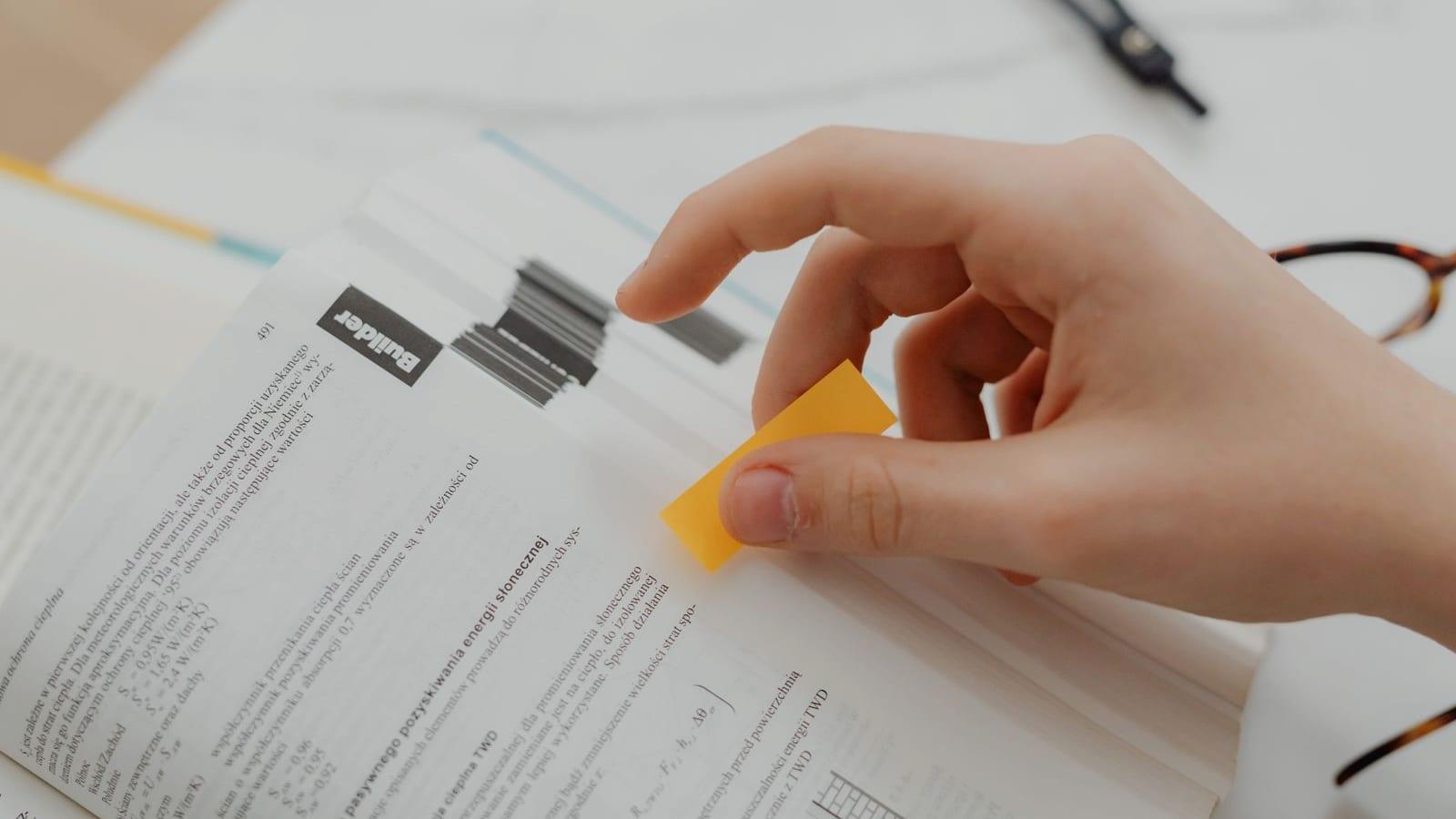
- Add tabs or sticky notes to the main sections of your book and notes, and label them with short words.
- Create a one-page index at the front: topic, page number, and a few keywords you would search for.
- Highlight sparingly. If half a page is yellow, nothing stands out.
- Mark worked examples, because they show you how to apply a rule, which is exactly what exams ask.
- Number your pages if they are loose, so the index stays correct.
Orbily can help with the first draft of that summary sheet. You can import your notes or a chapter by photo, audio or file, and the summary tool turns them into a condensed sheet you can then check, correct and complete from memory. It saves you the typing, but you remain responsible for deciding what belongs on the page and whether it is accurate, so always compare it with your source. You can read more about summary sheets.
Practise under real conditions
A well organised folder is useless if you have never used it under pressure. The only way to know whether your system works is to try it on realistic questions with the clock running.
Find past papers or sample questions and take one with your materials open and a timer set to the real exam length. Use only what you are allowed to bring. Afterwards, note two things: which questions took too long and why, and where your index or sheet failed you. Perhaps a topic had no tab, or the formula you needed was on the wrong page. Fix those problems straight away.
If you have never worked with old exams, read how to use past papers for the order and the conditions that make them most useful. Do at least two full runs before the exam, and make the second one harder by working quicker than the clock allows. Speed with your materials is a skill, and it improves with repetition.
How to work during the exam
Your strategy on the day matters as much as your preparation. Use these habits to avoid losing marks.
- Read the whole paper first and plan your time by marks, as you would in a closed exam.
- Start each answer from what you already know. Write the outline, then look up only the detail you are missing.
- Limit each search to a minute or two. If you cannot find something, note a short placeholder, move on and come back.
- Do not copy passages. Examiners want your reasoning, applied to the question, not a pasted paragraph.
- Cite or reference your source if the course asks for it, and do so in the style it requires.
- Leave five minutes at the end to check that every question has an answer.
If time is the main worry, the advice in how to manage time during an exam applies directly, with the same rule of budgeting minutes per mark.
Mistakes to avoid
Most open book failures come from a small set of habits.
- Studying less because the book will be there, then having no time to read it during the paper.
- Bringing a huge pile of material with no index, which feels safe but slows you down.
- Copying whole chapters into a sheet instead of summarising them.
- Learning the rules for the exam from other students rather than from the official instructions.
- Never practising with the materials, so the first time you use them is in the exam.
- Looking up everything, including things you knew, out of nerves.
A simple plan for the week before
Imagine an exam in seven days, with your textbook and one page of notes allowed. On the first two days, you work through the syllabus topic by topic, testing yourself from memory and listing what you could not recall. On the third day, you draft your one-page summary sheet and cut anything you already know well.
On the fourth day, you tab and index your textbook with short labels. On the fifth, you take a past paper with the clock running and the book open, and note where you lost time. On the sixth, you fix those problems and do a second, shorter practice on the weak topics. On the last day, you reread the summary sheet once, check that you have the right materials and stop early.
That plan takes the open book out of the realm of luck. You know the content, you can find the details and you have already practised in conditions close to the real thing. When the paper arrives, your book is no longer a crutch but a tool you know how to use.
FAQ
Usually not. Questions tend to ask you to apply ideas to new situations instead of repeating facts, and time is often tight. If you have not learned the material, you will spend the exam searching and run out of time. The book is a safety net, not a replacement for knowing the content.
Yes, the core ideas. If you know the main concepts and how they connect, you only need to look up details like exact figures, dates or formulas. Looking up everything is far too slow. A good rule is to memorise what you will use often and index what you will only need once.
It depends on the course. Some exams allow any printed book and your own notes, others only a set text or a single page. Check the exact rules with your teacher or in the exam instructions well before the day, and prepare only materials you are allowed to use.
Group them by topic, give each section a clear heading and add tabs or an index so you can find a page in a few seconds. Put key definitions, formulas and worked examples on a short summary sheet at the front. Anything you cannot find quickly is as good as missing.
Set a time budget per question from the marks available, just as in a closed book exam. Look things up only after you have started an answer from what you already know. If a search takes more than a minute or two, note what you were looking for, move on and return later.