

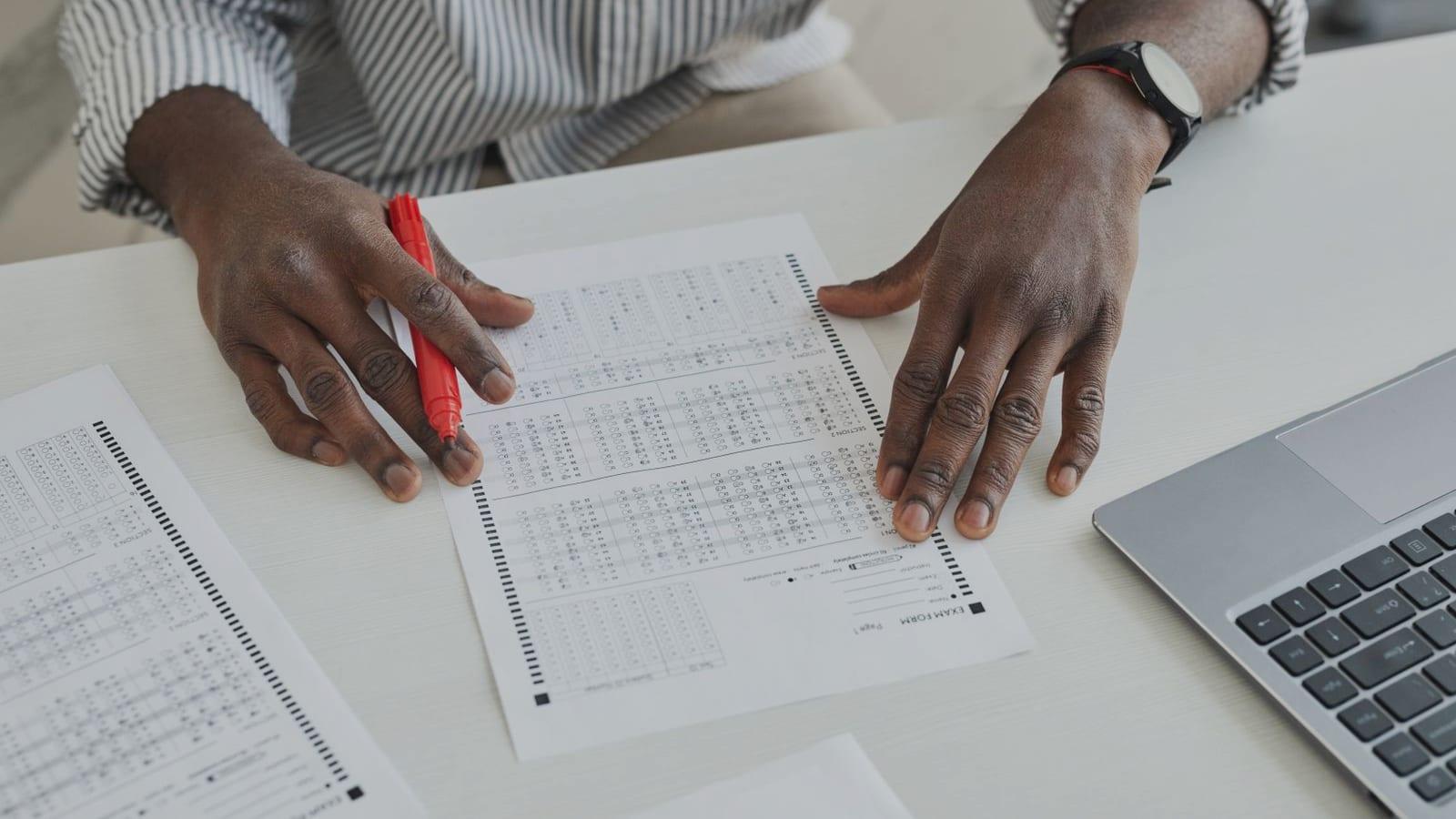
How to Correct a Practice Exam Yourself and Turn It Into a Study Plan
Published November 11, 2026
To correct a practice exam yourself, mark the whole paper with a mark scheme in a different colour, write beside every lost mark why you lost it, add up your total, and sort the losses by type: knowledge, method, wording or time. The pattern in those types, not the score, tells you what to revise next. That last step is what turns a finished paper into a better exam.
Most students do the first half of this. They sit the paper, glance at the answers, feel good or bad about the total and move on. The score is the least useful part of the whole exercise. It says how you did on that day, but nothing about what to do on Monday morning.
This guide is about marking a full paper, with several questions, several topics and a clock behind it. If you want to check a single question or a short set of exercises, how to check your own answers to practice questions goes through that case. Here we zoom out: the whole paper, the total, and the plan that follows.
Before you mark: make the paper count
Marking can only be as good as the paper you sat. A few choices before you start make the result much more reliable.
- Sit the paper under real conditions: the real time limit, no phone, no notes. A paper done in an easy setting overestimates your level, and how to use past papers explains how to set that up.
- Write every answer in full, as you would on exam day. Do not stop at "I know how to do this one".
- Mark any question you guessed, such as with a small cross in the margin. Guesses that landed on the right answer are still gaps.
- Note the time when you finish each section. You will need it later.
Do not look at the mark scheme until you are completely finished. Peeking in the middle turns practice into copying, and it ruins the one thing the paper was supposed to show you: what you can do alone.
Get the right mark scheme
The scheme is your marker. Using the wrong one gives you a false score, so check three things before you begin.
- Same paper. The scheme must match the exam year, session and version. Papers with similar names often have different questions.
- Same board or teacher. Wording that earns a mark in one system can lose it in another. If your teacher marks in a particular way, follow that.
- Full scheme, not just final answers. A list of answers without the marking points does not tell you why a mark was given. If all you have is an answer key, add the steps yourself using your notes.
If there is no official scheme at all, write a model answer for each question first, using your notes and textbook, and decide in advance what earns each mark. It takes longer, but writing the scheme is a form of revision in its own right.
Mark in a second colour, one question at a time
Take a pen in a colour you did not use for the exam. Go through the paper in order, question by question, and for each one do the same four things.
- Read the mark scheme for that question first, so you know what points are expected.
- Tick each point your answer clearly makes, and write the mark next to it.
- Circle the place where a point is missing, wrong or too vague.
- Write the question total in the margin, as a fraction, such as 3/5.
Be as strict as an examiner would be. Your answer must contain the point, not almost contain it. If you wrote "it gets bigger" and the scheme says "increases because the pressure rises", you may have noticed the right idea, but you did not give the reason, so the mark goes. When you cannot decide, award nothing and add a question mark, and ask a teacher later.
Handle method marks with care. In subjects such as maths or physics, you can earn marks for correct steps even when the final answer is wrong. Mark each step separately. This often shows that a paper you thought was a failure is closer to a pass, and that a page of "correct" answers hides a weak method.
Write the reason beside every lost mark
This is the step that makes marking useful. For every mark you lost, write a few words that explain why. Not "wrong", but something more exact.
- "Did not know the definition."
- "Knew it, but used the wrong formula."
- "Right idea, no reason given."
- "Misread the question and answered another one."
- "Ran out of time, left blank."
- "Arithmetic slip, correct method."
The goal is to separate what you do not know from what you know and still lost. Those two problems need opposite treatment. If you lack knowledge, you need to learn the topic again. If you lost marks through wording, you need to practise writing answers in the way the scheme expects. If you lost them through speed, you need a plan, and how to manage time during an exam gives you one.
Add up the score and read the pattern
Now add up the marks and write the total at the top, together with the percentage and the grade it would give you if your exam uses grade boundaries. A single number is not a prediction, so treat it as one reading and avoid either panic or celebration.
Then make a simple tally of your lost marks by type. A quick list on the back page is enough, with columns such as:
- Knowledge gaps (topic not learned or forgotten)
- Method errors (wrong approach or step)
- Wording (right idea, not enough detail)
- Careless slips (units, signs, misreading)
- Time (unfinished or rushed questions)
Count the marks in each column, not the number of questions. This tally is the real result of the paper. A student with 62 per cent and most losses in careless slips needs a different week from a student with 62 per cent and most losses in one unlearned topic. The same score, two opposite plans.
You can also group the lost marks by topic. If half of them come from the same two chapters, those chapters are where the next revision session begins.
Turn the result into a plan
A marked paper that leads to no action is wasted effort. Within a day, write a short plan with three parts.
- Fix the top two or three causes. Pick the biggest columns of your tally, not every mistake. A short, focused list gets done.
- Redo the questions you lost the most marks on. Close the scheme, answer them again from memory and compare. Doing it again is where the learning lands.
- Practise the weak topics with recall. Turn each gap into a question you can answer without notes, and come back to it after a few days. If you need a timetable for this, see how to make a revision timetable.
Keep every marked paper and your tally in one place. After the second or third paper, put the tallies side by side. If knowledge gaps are shrinking and careless slips are not, you know where the next effort should go. Seeing progress also helps motivation more than any pep talk.
Doing it with Orbily
Marking your own work is hard because you have to judge it, and for written answers there may be no scheme at all. Orbily's AI Correction can give you a first pass. Take a photo of your handwritten answer, add the question if you can, and Orbily grades it out of 100, quoting what you actually wrote, with a verdict, strengths, what to rework and detailed corrections. It is a useful second opinion when no teacher is available, but you still have to do the real work afterwards: understand each correction, log why you lost the mark and redo the question yourself. You can read more about AI Correction.
Common mistakes when marking a practice exam
- Marking with the paper and the scheme open together. You will see a point and tell yourself you meant it. Mark what is on the page.
- Giving generous marks for the idea. Real markers give marks for what you wrote, not for what you meant.
- Looking only at the total. The total hides the causes.
- Only fixing the questions you got wrong. Right answers reached by luck or by a shaky method need a look as well.
- Marking and moving on. If you never redo the weak questions, the next paper will show the same losses.
- Repeating the same paper too soon. You will remember the answers and fool yourself about your level. Leave time between attempts, or use a different paper.
A simple routine for the next paper
- Sit the whole paper in one go, timed, with no notes.
- Take a short break, then mark it the same day with a second colour.
- Write the reason beside every lost mark.
- Tally the losses by type and by topic.
- Choose two causes and write a plan for the next three days.
- Redo the biggest losses from memory two days later.
- Sit the next paper and compare the tallies.
After two or three rounds you will know your own pattern: which topics fail first, which kinds of mistakes you repeat and how you behave when the clock is running. That knowledge is worth more than any single score.
Final thoughts
Correcting a practice exam yourself is the moment when a paper turns into a plan. Use the right scheme, mark strictly in a second colour, write the reason for each lost mark, sort the losses by type and topic, and act on the biggest two or three causes. Do that and every paper you sit makes the next one easier, because you are no longer guessing what to revise. You are working from evidence.
FAQ
Use your notes, textbook and class examples to write a model answer for each question, then mark against that. Ask a teacher or a classmate to check the trickiest ones. A rough scheme you built yourself is far better than judging by feel, because it forces you to decide what earns a mark.
Be strict, as the real marker will be. Give a mark only when the scheme's point is clearly there. If you are unsure, do not give it, and note the doubt. A slightly low estimate on a practice paper is much safer than a flattering one that hides a weakness.
Soon, ideally the same day or the next one, while you still remember why you wrote what you wrote. That memory helps you find the cause of a mistake. Do not wait a week, but do take a short break first so you can read your own work with a clear head.
Yes, even more so. A weak score is full of information about what to fix. Marking tells you whether the problem is a few topics, careless errors or running out of time. That is far more useful than a general feeling of having done badly.
There is no fixed number. Two or three full papers, marked properly and followed by targeted revision, usually beat ten papers done quickly and left unmarked. Stop when your marks level off and your errors become rare and mostly careless.