

How to Study for a Physics Exam: Solve, Check, Repeat
Published November 23, 2026
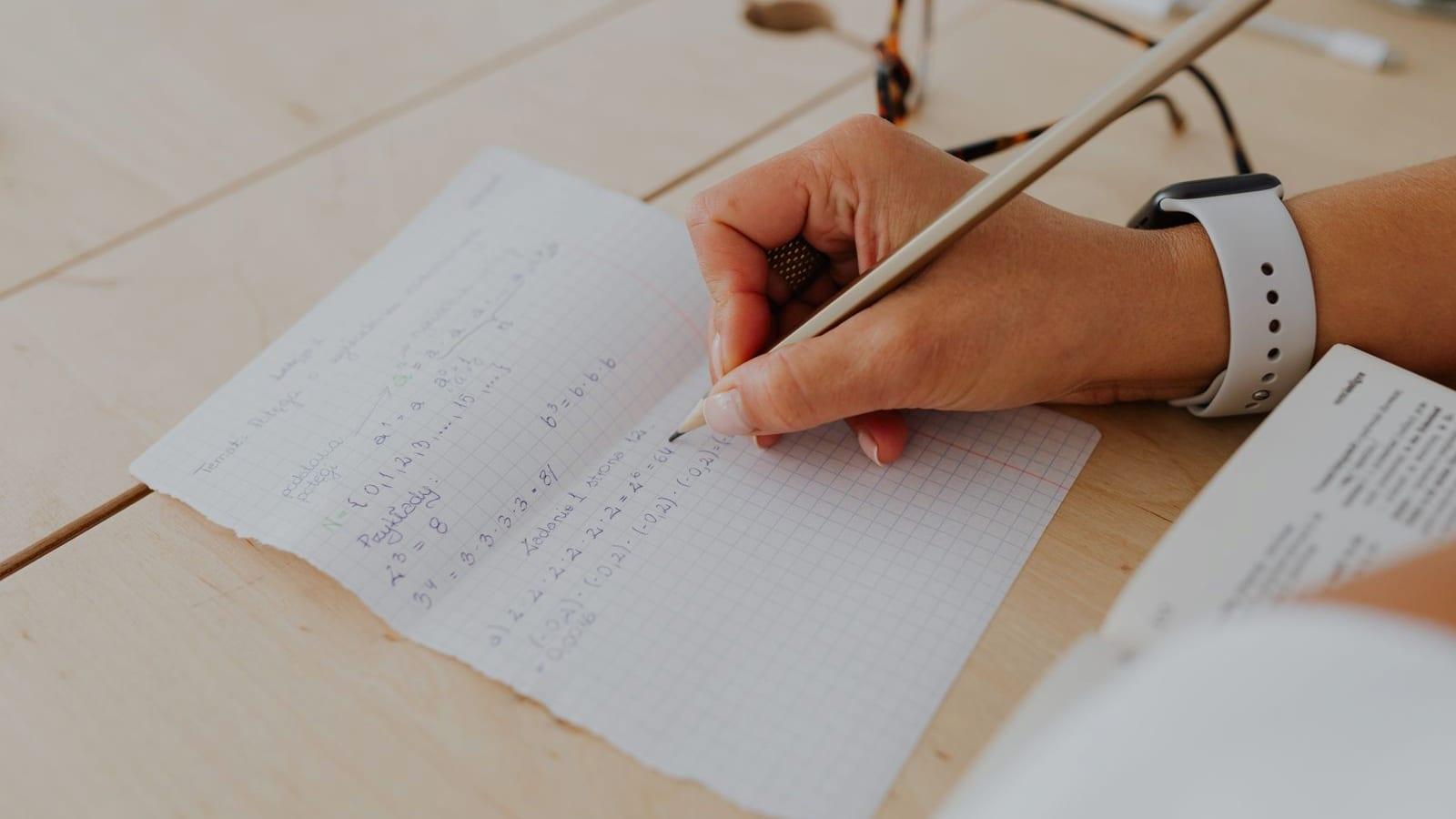
To study for a physics exam, learn the few principles behind each topic, then spend most of your time solving problems on paper, without looking at the solution first. Keep a short formula sheet and a log of the mistakes you repeat. Physics is a skill you build by doing, and reading your notes again will not build it.
Many students prepare for physics like they prepare for history. They reread the chapter, highlight the equations and feel ready. Then the exam shows a ramp, a spring and a friction coefficient in one question, and nothing in the notes looks like it. This guide gives you a method that matches how physics is actually tested, from the first week of revision to the morning of the exam.
Find out what the exam really asks
Before you study anything, collect the facts. Get the syllabus or the list of learning outcomes, and look at past papers if you can. Write down the topics covered, the types of question (multiple choice, short calculations, long multi-step problems, explanations) and how the marks are split.
Then sort the topics honestly into three groups.
- Strong: you can solve problems on it with your notes closed.
- Shaky: you follow the explanation but get stuck when you work alone.
- Weak: you cannot yet explain the basic idea.
Most of your time belongs to the shaky and weak groups. Students usually do the opposite, because practising a favourite topic is pleasant. Test the sort with real problems, not with a feeling. "I think I know mechanics" and "I solved five mechanics problems without help" are very different statements.
Physics also builds on itself. Forces come back in energy, energy comes back in thermodynamics, and algebra mistakes follow you everywhere. If a weak topic is the foundation of a later one, start there, even if it is not the most heavily weighted on the exam.
Understand the principle before the formula
Physics looks like a long list of equations, but almost every chapter grows from a few principles: conservation of energy, conservation of momentum, Newton's laws, and in later courses things like conservation of charge or the wave equation. If you understand the principle, the formula is a consequence. If you only memorise the formula, you will not know when to use it.
For each topic, write three things in your own words.
- The big idea in one or two sentences, as if explaining to a friend.
- The situations where it applies, and where it does not.
- A sketch of a typical case with the quantities labelled.
A good test is the "why" question. Why does the speed of a falling object not depend on its mass when air resistance is small? Why does the same total energy let a roller coaster reach a different speed at different heights? If you can answer without looking, you are ready for problems. If not, go back to the textbook or ask your teacher before you practise more.
Pay attention to units and to the meaning of each symbol. Many physics errors are not hard ideas but small slips: mixing up speed and velocity, using degrees where the formula needs radians, or forgetting that a force has a direction.
Solve problems every day, and start with the blank page
This is the core of the method. Physics exams are problem exams, so problems should take about three quarters of your study time.
Work through each problem like this.
- Read it twice and draw a diagram, even if the question gives one.
- Write the known values with units, and what you are asked to find.
- Name the principle you will use, and why it fits.
- Solve with symbols first, plug in numbers last, and keep the units attached.
- Check whether the answer has the right units and a sensible size.
Cover the solution until you have really tried. Following a worked example feels like understanding, but the test is whether you can reproduce it on a blank page. Roediger and Karpicke (2006) found that students who practised retrieving what they had studied remembered more a week later than students who simply reread it, even though the rereaders felt more confident (full paper). Solving a problem from scratch is retrieval in its most useful form for physics.
When you get stuck, give yourself a few minutes of honest effort. Then look at one hint, not the full solution, and try again. Struggling first makes the solution stick far better than reading it straight away.
Mix the topics as the weeks go by. After a few problems on a chapter, shuffle in questions from other chapters, so you also practise choosing the method. In the exam nobody tells you which chapter a question comes from.
Build a formula sheet that explains itself
Make one or two pages with every formula you may need. For each one, write the equation, what each symbol means with its unit, the conditions under which it holds and a tiny sketch. For example, the equations of motion only hold for constant acceleration, and that condition is the thing students forget.
Making the sheet is useful in itself. Choosing what to include forces you to see how formulas connect, such as how kinetic energy, work and force are tied together. Check the rules of your exam. If you receive a formula sheet, practise using it so finding a constant takes seconds. If you may bring your own, build it carefully. If you may bring nothing, treat it as a memory aid that you rebuild from a blank page.
Do not just copy the sheet. Test yourself by covering the right-hand side and writing the condition and units from memory. Facts like these respond well to short, spaced practice. Cepeda and colleagues (2006) reviewed many studies and found that spreading practice over time improves long-term retention compared with massing it together. Come back to the hard formulas more often than the easy ones.
Once you have the list, you can use the formulas without searching for them. Take a photo of your notes or a solved example and Orbily can pull the formulas out for you, together with the conditions where each one applies, so you start from a clean list instead of rewriting everything. You still have to decide when to use each formula and solve the problems yourself, because that is the part the exam tests. You can see how it works on the Formulas page.
Keep an error log
Each time you get a problem wrong, write one line: the topic, what went wrong and what you will do differently. Typical entries look like this.
- Forgot to convert centimetres to metres.
- Used the wrong sign for the direction of the force.
- Picked energy conservation when friction made it invalid.
- Solved for the wrong quantity and stopped one step early.
After a week, patterns appear. Most students repeat the same three or four mistakes, and a log that names them is the cheapest way to fix them. Before each session, read the last few entries. Before the exam, read the whole log.
Then redo the problems you missed, a few days later, without looking at the solution. If you can solve them cold, the mistake is fixed. If not, it goes back on the list. For a deeper method on this, see our guide to checking your own answers.
Practise the types of problems that appear again and again
Every course has a short list of problem types that return in almost every exam. In mechanics, that is usually motion with constant acceleration, forces on inclines and in circles, energy and momentum in collisions. In electricity, it is circuits with resistors and fields from point charges. In waves and optics, it is the relationship between speed, frequency and wavelength, and simple lens or mirror problems.
For each type, write one worked example in your own handwriting, with the steps in order. When you meet a new problem of that type, compare your steps against your example. If a step is missing, you will see it at once. These examples are also the best material to reread on the last evening, because they are in your own words.
Do not forget the questions that ask for an explanation, not a number. Practise saying why a result makes sense: why the answer should increase when mass decreases, or what happens in the limit when a quantity becomes very large. These questions often carry easy marks, and they reward the principle-first study from earlier.
Use past papers and time yourself
About two weeks before the exam, start doing full past papers under real conditions. Set a timer, close your notes and work without interruptions. Then mark the paper with the mark scheme and look closely at how marks are given. In many exams, a correct method earns marks even when the final number is wrong, so showing your steps is worth real points.
After each paper, add the errors to the log and redo the missed questions a few days later. Our guide on how to use past papers walks through the order and the marking. One paper done carefully teaches more than three done in a rush.
If you are short on time, choose by value. Start with the topics that carry many marks and where you are shaky, and leave the strong topics for a quick check.
A two-week plan you can adapt
- Days 1 and 2: Collect the syllabus, sort topics into strong, shaky and weak, and start the formula sheet.
- Days 3 to 8: Work through the weak and shaky topics, one or two a day, with about three quarters of each session on problems.
- Days 9 to 11: Mix topics, redo the problems in your error log and test yourself on the formula sheet.
- Days 12 and 13: Do full past papers under time, mark them and update the log.
- Day 14, the day before: Light review of the sheet and the log, redo two or three problems, pack your calculator and sleep.
With less time, keep the same shape and shrink each block. Problem practice and the error log give the most value per hour. For a general method, see how to revise for an exam in a week.
On exam day
Read each question twice. Underline what is asked and circle the given values. Draw a quick diagram, write the principle, solve with symbols and substitute at the end. If a question is taking too long, mark it and move on, because a hard question early can eat the time you need for easy marks later.
Leave a few minutes to check units, signs and whether the answer is realistic. A car travelling at a million metres per second is a clue that a unit slipped. Keep your sleep sensible the night before, because multi-step reasoning is the first thing a tired brain loses.
Common mistakes to avoid
- Rereading notes instead of solving problems. It feels productive and produces the least.
- Memorising formulas without their conditions. They break the moment a question changes shape.
- Skipping the diagram. Most sign errors start with a missing sketch.
- Looking at the solution too early. Struggle first, then check.
- Never redoing missed problems. The mistake you do not fix comes back in the exam.
- Practising only your favourite topic. Time belongs to the weak ones.
What to remember
Physics rewards students who practise. Sort topics honestly, learn the principle behind each formula, solve problems on a blank page every day, keep a formula sheet and an error log, and do timed past papers in the final weeks. If you change only one thing, replace some of your rereading with problems you have not seen before.
FAQ
Because exam questions are new combinations of ideas, not copies of what you saw in class. Rereading notes feels like progress but trains recognition, and the exam needs you to build a solution from nothing. The fix is practice: solve unfamiliar problems on paper until choosing a method becomes a habit.
Memorise the few you use all the time, like the equations of motion or Newton's second law, and know where the rest come from. More important than the formula is knowing when it applies. Check whether your exam gives a formula sheet, and if it does, practise with it.
There is no magic number, but aim for several each day over two or three weeks, and make them varied. Quality matters more than count: after each problem, check your method and note why you went wrong. Ten problems you fully understand beat thirty you only copied.
That is very common. Following an explanation is easier than producing one. Start with the problem, not the solution, and struggle for a few minutes before you look. Then redo the same problem a few days later without help. That gap between following and doing is exactly what practice closes.
Both can work. Attempt problems alone first, because that is how the exam works. Then use a group to compare methods and explain your reasoning aloud. Teaching a step to someone else quickly shows whether you really understand it or only recognise it.